
What Is a Franna Crane? How Pick-and-Carry Cranes Work
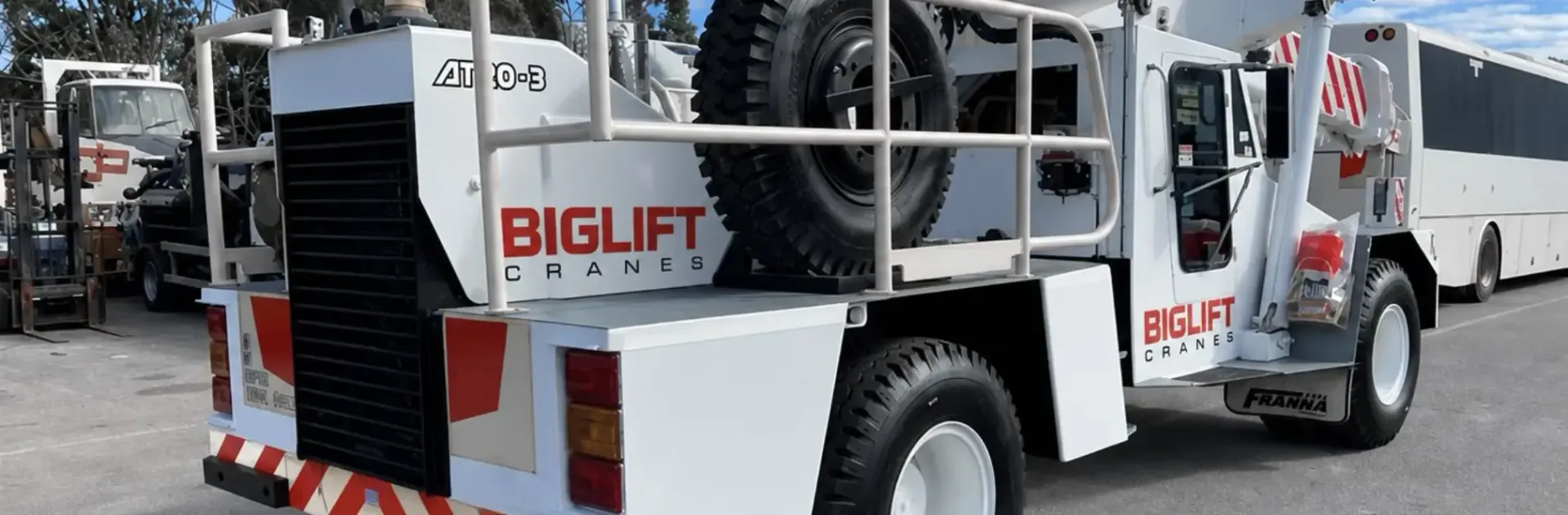
A
Franna crane is a type of pick-and-carry mobile crane designed to lift and move loads around a worksite.
Franna cranes use an articulated frame and do not require conventional outriggers, allowing them to manoeuvre and reposition loads without the same type of outrigger setup used by many other mobile cranes.
Franna® is a Terex brand, while “pick-and-carry crane” describes the broader type of crane.
For projects where a load needs to be lifted and repositioned around a site, this combination of lifting capability and mobility can be useful. However, the right crane still depends on the load, required reach, working conditions, access and other project requirements.
Key Takeaways
- A Franna is a pick-and-carry mobile crane designed to lift and move loads around a suitable worksite.
- Franna is a brand name, while pick-and-carry crane is the broader equipment category.
- Its
articulated frame provides manoeuvrability without conventional outriggers.
- Pick-and-carry means the crane can lift and travel with a suspended load when the operation is within the manufacturer's requirements and site conditions allow it.
- A Franna's
maximum tonne rating is not its capacity for every lift. Radius, boom configuration, articulation and operating conditions can affect rated capacity.
- Franna cranes are used for machinery relocation, construction, industrial work, equipment positioning and other mobile lifting applications.
What Makes a Franna a Pick-and-Carry Crane?
A Franna is a pick-and-carry crane because it is designed to lift a load and move it within a work area, rather than only lifting from a fixed position.
Terex describes Franna cranes as pick-and-carry cranes that combine lifting capability with steering flexibility and an articulated frame that does not require conventional outriggers.
The term
Franna refers to Terex's pick-and-carry crane brand. In Australia, the name is closely associated with this type of crane, but “pick-and-carry crane” remains the broader equipment description.
The defining characteristics are:
| Feature | What it means |
|---|---|
| Pick-and-carry capability | Designed to lift and move loads within suitable operating conditions |
| Articulated frame | The chassis articulates to help the crane manoeuvre |
| Telescopic boom | Extends to provide lifting reach |
| No conventional outriggers | Avoids the conventional outrigger setup used by many other mobile cranes |
| Mobile design | Allows the crane to travel between suitable work areas |
What Does “Pick and Carry” Mean?
Pick and carry means a crane can pick up a load and travel with it to another position when the operation is permitted by the crane's specifications and site conditions. This is the feature that gives Franna cranes their distinctive role.
The concept is simple:
Pick up → travel → position → place
The important distinction is that the load is being moved
with the crane, rather than the crane simply lifting from one fixed position.
However, pick-and-carry does not mean a Franna can travel anywhere with any load.
SafeWork NSW guidance on pick-and-carry operations advises that mobile cranes travelling with freely suspended loads should avoid slopes unless the load remains within the manufacturer's allowable rated lifting capacities.
The guidance also highlights the importance of assessing the travel path and ground conditions.
So the key point is:
Pick-and-carry is a crane operating function, not a guarantee that every load can be carried across every worksite.
How Does a Franna Crane Work?
A Franna combines an articulated chassis, telescopic boom and lifting system to lift, manoeuvre and position loads around a worksite.
The
articulated chassis allows the crane to steer and manoeuvre through tighter areas. The
telescopic boom provides lifting reach, while the lifting equipment connects the crane to the load.
Because Franna cranes use an articulated pick-and-carry design, they do not use conventional outriggers. Terex identifies the lack of outriggers as one of the features that allows Franna cranes to be set up quickly and manoeuvred in tight spaces.
Why does the articulated frame matter?
The articulated frame improves manoeuvrability, but articulation can also affect stability and rated capacity during operation.
Research from the
University of Western Australia examined non-slewing articulated mobile cranes and identified factors including articulation angle, slope gradient, orientation angle and boom height in relation to crane stability.
The research is presented in a master's thesis on the static modelling and stability of non-slewing articulated mobile cranes.
This means the articulated design is both a mobility feature and an operating factor that needs to be considered when planning a lift.
Key parts of a Franna crane
| Component | Purpose |
|---|---|
| Telescopic boom | Provides lifting reach |
| Articulated frame | Allows steering and manoeuvrability |
| Chassis | Supports and moves the crane |
| Lifting equipment | Connects the crane to the load |
| Lifting equipment | Provides controls and visibility for the operator |
What Are Franna Cranes Used For?
Franna cranes are used for lifting and repositioning loads where mobility around the worksite is important. Terex identifies applications across industries including construction, oil and gas, mining and infrastructure.
Common applications include:
- Machinery relocation
- Equipment positioning
- Construction material handling
- Steel erection
- Industrial maintenance
- Equipment installation
- Pipe and component handling
- Short-distance movement of loads around a worksite
For example, a contractor may need to move machinery from one part of a site to another before positioning it at its final location. A pick-and-carry crane can be useful when the job requires both
lifting and movement, rather than one stationary lift.
The type of project alone does not determine whether a Franna is suitable. The more important factors are the
load, movement required, access, radius and operating conditions.
What Are the Advantages of a Franna Crane?
The main advantages of a Franna are mobility, manoeuvrability, pick-and-carry capability and reduced conventional setup requirements.
Terex highlights steering flexibility, manoeuvrability in tight spaces and the absence of conventional outriggers as key characteristics of the Franna design.
Mobility
A Franna can be useful when a load needs to be repositioned between different locations within a work area.
Manoeuvrability
The articulated chassis allows the crane to manoeuvre where turning space may be limited.
Pick-and-carry capability
The crane combines lifting and movement, which can be useful when loads need to be repositioned rather than lifted once and left in place.
Reduced conventional setup
Because a Franna does not use conventional outriggers, it avoids the same type of outrigger deployment required by many other mobile crane configurations. Terex identifies the no-outrigger design as a feature that allows quick setup.
These characteristics explain
why a Franna may be useful. They do not mean a Franna is automatically the best choice for every lifting job.
What Are the Limitations of a Franna Crane?
A Franna's mobility does not remove the need to consider load capacity, ground conditions, slopes, articulation, travel paths and other operating factors.
WorkSafe Victoria guidance on preventing pick-and-carry crane overturning identifies factors associated with overturning of articulated pick-and-carry cranes, including:
- Unsuitable ground conditions
- Slopes
- Failure to derate lifting capacity
- Excessive boom angle or extension
- Uncontrolled load sway
- Changes in direction or articulation
- Excessive speed
- Under-inflated tyres
This leads to an important distinction:
No conventional outriggers does not mean no stability considerations.
In some situations, another type of plant may be more appropriate. WorkSafe Victoria recommends considering alternative plant where doing so can eliminate or reduce risks associated with moving a load.
How Much Can a Franna Crane Lift?
A Franna's lifting capacity depends on its model and operating configuration, so its maximum tonne rating should not be treated as the capacity available for every lift.
Terex Franna product range currently lists the following Australian Franna models:
| Franna model | Maximum capacity | Maximum main boom length |
|---|---|---|
| AT22-2 | 22 tonnes | 17.9 m |
| MAC25-5 | 25 tonnes | 18.4 m |
| AT40-2 | 40 tonnes | 19.8 m |
These are manufacturer specifications for the listed models. They are
maximum capacities, not a statement that the crane can lift that amount at every radius or configuration.
For the AT22-2, Terex states that its Dynamic LMI calculates rated capacity in real time while accounting for factors including
boom configuration, chassis articulation, pitch and roll.
Other factors relevant to the capacity available for a particular lift include:
- Load weight
- Working radius
- Boom configuration
- Articulation
- Ground conditions
- Slope
- Load-handling equipment
- Manufacturer's rated-capacity requirements
SafeWork NSW also explains that rated lifting capacity depends on factors including boom length and load radius and requires operators to work within the crane's rated capacities and operating information.
A simple example
A 20-tonne load does not automatically mean that a 20-tonne-rated Franna is suitable.
The required crane depends on where the load is picked up, where it needs to go, the working radius, lifting height, configuration and site conditions.
That is why crane selection should start with the
lift, not just the crane's headline capacity.
Franna Crane vs Other Mobile Cranes
A Franna is primarily distinguished by its pick-and-carry capability, while other mobile crane types may be selected when different combinations of reach, capacity, setup or site access are more important.
| Feature | Franna / Pick-and-Carry | All-Terrain Crane | City Crane |
|---|---|---|---|
| Primary function | Lift and reposition loads | Mobile lifting with emphasis on reach, capacity and terrain | Lifting in urban and restricted environments |
| Pick-and-carry | Core capability | Not the primary function | Not the primary function |
| Conventional outriggers | No | Yes | Typically used |
| Mobility around site | High | High | Depends on model and site |
| Setup requirements | Generally lower | More involved | Model and site dependent |
| Key selection factor | Need to lift and move loads | Reach, capacity, access and terrain | Urban access and lifting requirements |
This is a
category-level comparison, not a specification sheet for every crane model. Individual cranes can differ significantly.
The simplest distinction is:
- Franna: when mobile lifting and repositioning are central to the job.
- All-terrain crane: when reach, capacity and terrain capability are more important.
- City crane: when the project requires a crane suited to urban or restricted-site lifting.
When Is a Franna Crane the Right Choice?
A Franna may be suitable when a project requires lifting and repositioning within a worksite, and the load, radius, travel path and operating conditions fall within the crane's rated capacity and manufacturer's requirements.
A Franna may be worth considering when:
- The load needs to move between locations on the site.
- Repeated repositioning is required.
- Manoeuvrability is important.
- Conventional outrigger deployment would not suit the work area.
- The required lift falls within the crane's rated capacity.
- The travel path and ground conditions are appropriate for the planned operation.
A different crane may be more appropriate when the project requires substantially different reach, capacity, setup or operating characteristics.
How crane selection works
Crane selection starts with the job requirements and then matches those requirements to an appropriate crane.
A practical process is:
1. Define the load
Determine the load's weight and dimensions.
2. Define the lift
Establish the required lifting height, working radius and pickup and placement locations.
3. Assess the site
Consider access, working space, ground conditions, travel path and other site restrictions.
4. Match the equipment
Compare those requirements with the available crane's capacity, configuration and operating limitations.
This approach is more reliable than choosing a crane simply because its advertised capacity appears to match the load.
What Information Does a Crane Hire Company Need?
A crane hire company needs information about the load, lift and site so it can assess which crane is appropriate.
The most useful details are:
| Project information | Why it matters |
|---|---|
| Load weight | Helps determine required crane capacity |
| Load dimensions | Helps assess handling and positioning |
| Lift height | Helps determine required reach |
| Working radius | Affects rated lifting capacity |
| Pickup location | Helps establish crane positioning |
| Placement location | Defines where the load needs to be positioned |
| Site access | Determines which crane types can reach the work area |
| Ground conditions | Relevant to crane suitability and stability |
| Travel requirements | Important when pick-and-carry operation is involved |
| Site restrictions | May affect crane size or configuration |
Photos, the site address and a description of the lifting task can also make an initial assessment more useful.
SafeWork NSW advises that people hiring or using mobile cranes should ensure the appropriate operator licences, crane documentation and load charts are available and that the equipment and operators are suitable for the work.
In NSW,
non-slewing mobile cranes over 3 tonnes capacity fall under the CN high-risk work licence class. SafeWork NSW identifies articulated mobile cranes within this non-slewing mobile crane category.
The exact licensing and compliance requirements depend on the equipment and work being performed, so current NSW requirements should be checked rather than relying on a general article.
Frequently Asked Questions
Is a Franna crane the same as a pick-and-carry crane?
Franna is a Terex brand of pick-and-carry cranes, while “pick-and-carry crane” is the broader equipment category.
Can a Franna crane move with a suspended load?
Yes, moving with a suspended load is a defining pick-and-carry capability, provided the operation remains within the manufacturer's requirements and site conditions allow it.
SafeWork NSW specifically highlights the effects of slopes, ground conditions and travel paths during pick-and-carry operations.
Does a Franna crane need outriggers?
No. Franna's articulated design does not require conventional outriggers. This is one of the characteristics that distinguishes it from many other mobile crane configurations.
How much can a Franna crane lift?
It depends on the model and operating conditions. Terex's current Australian range includes the 22-tonne AT22-2, 25-tonne MAC25-5 and 40-tonne AT40-2, but actual rated capacity depends on the crane's configuration and operating conditions.
What are Franna cranes used for?
They are used for suitable lifting and repositioning work across construction, infrastructure, industrial, mining and other applications.
Can a Franna work on a slope?
Only when the crane's manufacturer requirements and rated capacity allow the operation. Slopes can reduce lifting capacity and affect stability, so they must be considered as part of the lift assessment.
What is the difference between a Franna and an all-terrain crane?
A Franna is designed around pick-and-carry lifting and manoeuvrability, while an all-terrain crane is generally selected for different combinations of reach, capacity, access and terrain capability. The appropriate choice depends on the project.
How do I know whether I need a Franna crane?
Start with the load, required height and radius, site access, ground conditions and whether the load needs to be repositioned while suspended. Those details can then be assessed against the available crane options.
Franna Crane Hire in Sydney
If you need a Franna for a Sydney project, BIGLIFT CRANES lists a
20T Franna as part of its mobile crane fleet.
A Franna can be considered for suitable pick-and-carry work where mobility around the worksite is an important part of the lifting requirement.
The right crane still depends on the individual job. When you contact us, provide the load details, required lifting height and radius, site address, access information and relevant site conditions. We can then assess the requirements against the available crane options.